

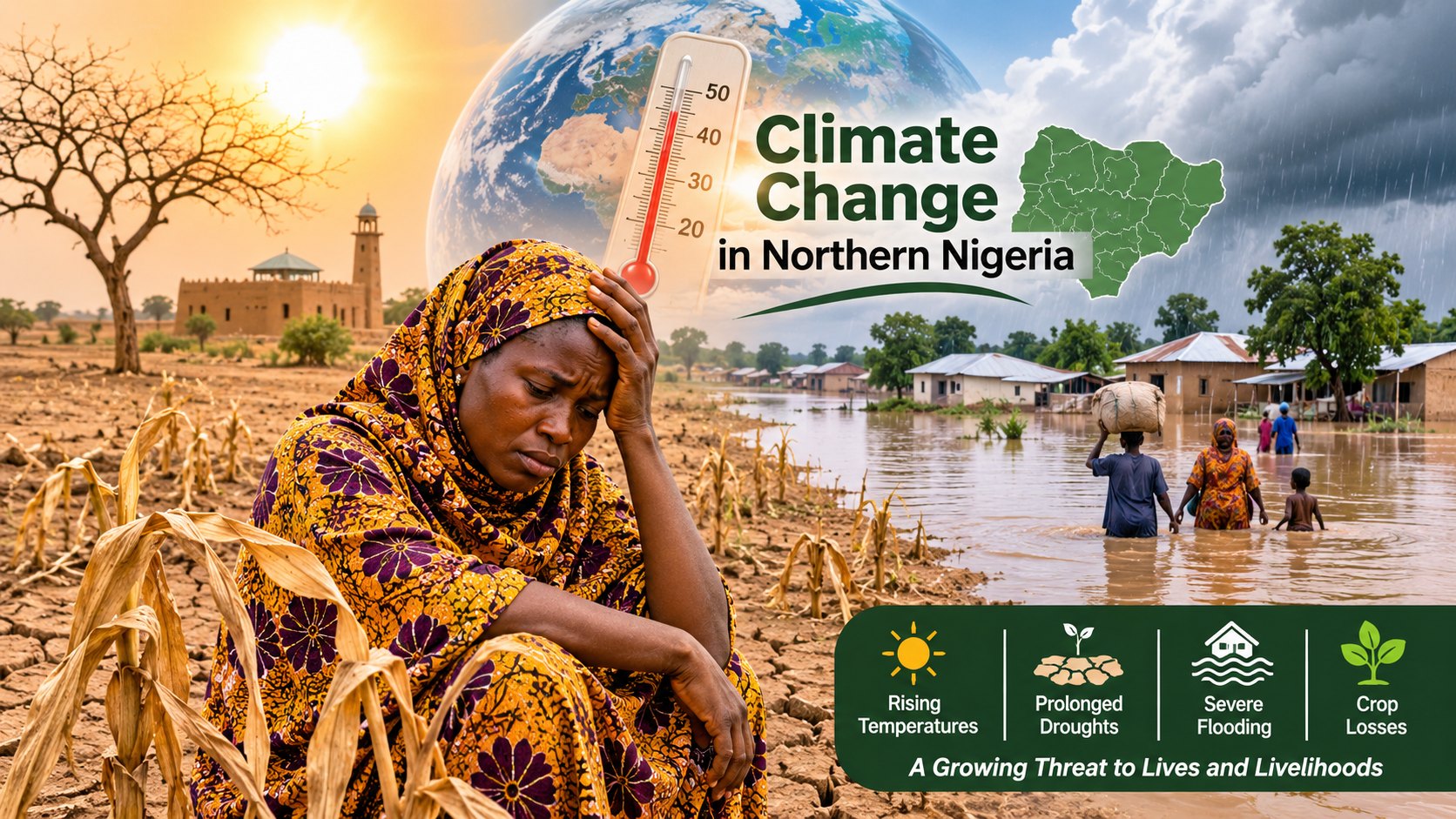
In Northern Nigeria, the arrival of the rainy season has always carried a special meaning.
For farmers, it signals the beginning of another agricultural cycle. Land is prepared, seeds are selected, and expectations are placed on the rains that will determine the success of the coming harvest.
But what happens when the rain no longer arrives when expected?
What happens when a season that once followed familiar patterns becomes unpredictable? When temperatures rise, dry spells become more difficult to manage, and floods destroy crops that families have spent months cultivating?
For many communities across Northern Nigeria, these are not distant environmental possibilities.
They are increasingly important realities.
Climate change is reshaping the conditions under which people grow food, manage natural resources and sustain their livelihoods.
And perhaps nowhere is this challenge more visible than in the agricultural communities that depend directly on the land.
Understanding the Climate Challenge in Northern Nigeria
Northern Nigeria includes diverse ecological zones, ranging from the Sahel in the far north to the Sudan and Guinea savannah regions further south.
These landscapes support millions of people through agriculture, livestock production, trade and other economic activities.
However, their environmental conditions are changing.
Rising temperatures, rainfall variability, land degradation, drought and flooding are placing additional pressure on already vulnerable communities.
Nigeria’s Department of Climate Change identifies significant climate risks across the country.
Its national climate-risk information highlights projected temperature increases of approximately 2.5°C to 3.2°C by 2050 under the scenarios presented, alongside an average of 107 consecutive dry days annually in the northern region.
These figures demonstrate why climate resilience must become a central development priority.
1. Rising Temperatures: When the Heat Becomes a Threat
Northern Nigeria is already characterised by high temperatures, particularly during the dry season.
However, increasing temperatures create additional challenges for people, agriculture and ecosystems.
Extreme heat can increase evaporation, accelerate soil moisture loss and place additional stress on crops and livestock.
For farmers, this can mean:
- Faster drying of agricultural soils.
- Increased water requirements for crops.
- Heat stress during critical crop development stages.
- Reduced livestock productivity.
- Greater pressure on water resources.
For people working outdoors, extreme heat also creates occupational health risks.
Farmers, agricultural labourers, traders and other outdoor workers may experience heat exhaustion and other heat-related illnesses.
The implications extend beyond agriculture.
As temperatures rise, communities may face increasing demand for water, electricity, cooling and other essential services.
2. Prolonged Droughts and the Uncertainty of Rainfall
Rainfall is one of the most important determinants of agricultural productivity in Northern Nigeria.
Most smallholder farmers depend heavily on seasonal rainfall to grow crops.
However, rainfall variability can make agricultural planning increasingly difficult.
A rainy season may begin later than expected. Rainfall may stop for extended periods after planting. In other cases, intense rainfall may occur over a short period, leaving little time for water to infiltrate the soil.
These conditions can affect germination, crop development and final yields.
For farmers cultivating maize, millet, sorghum, groundnuts and other important crops, prolonged dry spells can result in significant losses.
Livestock farmers also experience pressure when pasture and water become less available.
The problem is not simply the absence of rain.
It is the growing difficulty of knowing when rain will arrive, how much will fall and how long it will last.
3. Flooding: When Too Much Rain Becomes a Disaster
While drought receives considerable attention in discussions about Northern Nigeria, flooding is another serious climate-related threat.
Intense rainfall, poor drainage, river overflow, land-use changes and inadequate infrastructure can combine to produce devastating floods.
The consequences can include:
- Destruction of homes and infrastructure.
- Loss of agricultural land and standing crops.
- Soil erosion and degradation.
- Contamination of drinking water.
- Displacement of households.
- Disruption of local markets and livelihoods.
Nigeria experienced particularly devastating flooding in 2022, affecting more than 4.4 million people and displacing over 2.4 million across the country, according to the National Emergency Management Agency (NEMA).
Flooding is not simply an environmental event.
It can reverse years of household investment, destroy food supplies and push vulnerable families further into poverty.
For farmers, a single flood can destroy months of preparation, labour and financial investment.
4. Agriculture and Food Security Under Pressure
Agriculture is central to the economy and livelihoods of Northern Nigeria.
Millions of households depend on farming directly or indirectly.
The region produces important food and cash crops, supports livestock systems and contributes significantly to Nigeria’s agricultural supply chains.
But agricultural production depends on a delicate relationship between soil, water, temperature and weather.
When these conditions become unstable, food production becomes more difficult.
Climate-related agricultural challenges can contribute to:
- Reduced crop yields.
- Increased pest and disease pressure.
- Livestock losses.
- Higher production costs.
- Increased food prices.
- Reduced household income.
Smallholder farmers are particularly vulnerable because many have limited access to irrigation, agricultural insurance, climate information, improved seeds and affordable financing.
The consequences are not limited to farmers.
When agricultural production is disrupted, consumers, traders, food processors and entire local economies can feel the impact.
Climate resilience is therefore not just an agricultural concern.
It is a food security and economic development priority.
5. Women Farmers: Carrying a Disproportionate Burden
Climate change does not affect everyone equally.
Women in rural communities often face additional barriers when environmental conditions deteriorate.
Many women participate in farming while also managing household responsibilities, childcare, water collection and other unpaid activities.
When drought reduces water availability or agricultural production declines, these responsibilities can become even more demanding.
Women farmers may also have less access to land ownership, agricultural financing, improved technologies and formal extension services.
This creates an important development challenge.
Climate adaptation programmes must recognise women not simply as beneficiaries but as agricultural decision-makers, innovators and essential contributors to food systems.
Building climate resilience requires ensuring that women have access to the resources, information and technologies needed to adapt.
6. Why Traditional Farming Approaches May No Longer Be Enough
Agricultural knowledge developed over generations remains valuable.
However, increasingly unpredictable environmental conditions require farmers to complement traditional knowledge with more timely and reliable information.
Knowing when to plant, which crop varieties to select, how to manage soil moisture and when to prepare for extreme weather can make an important difference.
This is where climate-smart agriculture becomes relevant.
Climate-smart agricultural practices include:
Drought-tolerant crop varieties. Selecting suitable varieties that can withstand periods of limited water availability.
Conservation agriculture. Reducing unnecessary soil disturbance, maintaining soil cover and improving soil structure.
Agroforestry. Integrating appropriate trees into agricultural landscapes to support soil protection, biodiversity and diversified livelihoods.
Efficient irrigation. Using water more strategically to reduce unnecessary losses.
Crop diversification. Reducing dependence on a single crop and spreading agricultural risk.
Climate information services. Using weather forecasts and environmental information to make better-informed farming decisions.
These practices are not universal solutions. Their effectiveness depends on local conditions, affordability and appropriate implementation.
But together, they offer opportunities to build more resilient agricultural systems.
7. Technology and Artificial Intelligence: A New Opportunity for Climate Adaptation
One of the biggest challenges in climate adaptation is ensuring that useful environmental information reaches the people who need it.
Scientists may have access to satellite observations, climate models, weather forecasts and sophisticated environmental datasets.
But a smallholder farmer may simply need to know:
Will it rain this week?
Is my farm experiencing water stress?
Should I plant now or wait?
What should I do if my crops are showing signs of stress?
This is where technology can help bridge the information gap.
Satellite imagery can provide information about vegetation health, land conditions and changes in surface moisture.
Weather intelligence systems can help interpret forecasts and identify potential agricultural risks.
Artificial intelligence can help translate complex information into practical recommendations that farmers can understand.
For example, vegetation indices such as the Normalised Difference Vegetation Index (NDVI) can help monitor vegetation conditions, while the Normalised Difference Moisture Index (NDMI) can provide insights into vegetation moisture.
When combined with reliable weather information and local agricultural knowledge, these technologies can support more informed decisions.
At Greenium Eco, we believe that agricultural innovation must go beyond introducing technology for its own sake.
It must solve real problems.
This thinking informs our work through AgroTell, an AI-powered agricultural intelligence platform designed to make satellite-based farm monitoring, weather intelligence and agricultural guidance more accessible to smallholder farmers.
The objective is simple. make useful information easier to understand, access and apply.
Technology cannot stop droughts or prevent every flood.
But it can help farmers prepare, respond and make better decisions.
8. What Must Change?
Addressing climate change in Northern Nigeria requires more than occasional interventions after disasters occur.
It requires long-term investment in adaptation and resilience.
Governments, agricultural institutions, technology companies, researchers, development organisations and local communities all have important roles to play.
Priority actions should include:
Investing in climate-resilient agriculture. Supporting farmers with improved seeds, irrigation, soil management and appropriate agricultural technologies.
Strengthening early warning systems. Ensuring communities receive timely information about extreme rainfall, flooding, heat and drought.
Expanding access to climate information. Making weather forecasts and satellite-based agricultural information available in accessible formats and local languages.
Restoring degraded landscapes. Supporting sustainable land management, tree restoration and responsible natural resource use.
Financing smallholder adaptation. Improving access to affordable credit, agricultural insurance and climate finance.
Empowering women farmers. Removing barriers that limit women’s access to land, finance, agricultural training and technology.
Most importantly, climate adaptation strategies must be designed around the actual needs of the communities they are intended to serve.
The Future of Northern Nigeria Depends on What We Do Today
Climate change is often discussed through global statistics, international agreements and scientific projections.
But its consequences are experienced locally.
They are experienced by the farmer watching the rain clouds disappear before planting is complete.
By the family whose farmland is submerged after intense rainfall.
By the woman who must travel farther to access water.
By the livestock owner struggling to find pasture.
And by the young person wondering whether agriculture can still provide a sustainable future.
Northern Nigeria does not lack agricultural potential.
It has productive communities, experienced farmers, valuable natural resources and enormous opportunities for innovation.
What it needs is greater investment in resilience, better access to information, stronger agricultural systems and solutions that respond to the realities of its people.
The climate challenge is real, but so is the opportunity to respond differently.
We must move from reacting to environmental disasters towards anticipating risks, strengthening communities and building agricultural systems capable of adapting to changing conditions.
The future of food security in Northern Nigeria will not depend on rainfall alone. It will also depend on knowledge, innovation, preparedness and the decisions we make today.