

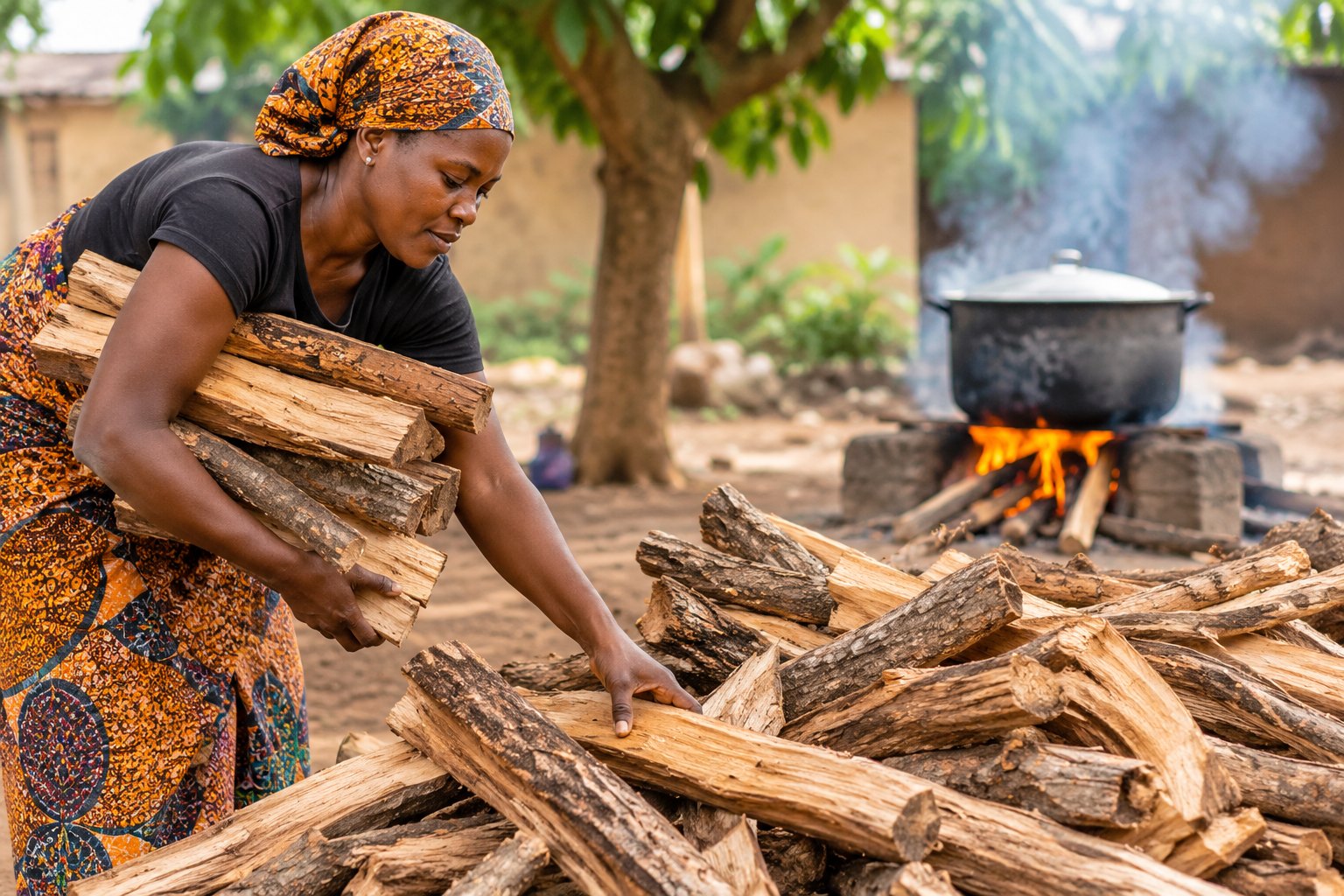
Every morning, across villages and rural communities, the search for firewood begins.
For some women, it means walking considerable distances to find branches and fallen trees. For others, it means purchasing bundles of wood, often using money that could have supported other household needs.
The wood is gathered, arranged beneath a cooking pot and ignited.
Within minutes, a meal begins to cook.
It is an ordinary scene repeated in millions of households. Yet the consequences of this everyday activity extend far beyond the cooking area.
Firewood has supported human civilisation for thousands of years. It has provided warmth, enabled food preparation and served as an important energy source for communities with limited access to modern alternatives.
But as populations grow and natural resources face increasing pressure, our dependence on traditional biomass fuels raises an important question:
What is the true cost of the energy we use to cook our food?
The Growing Dependence on Firewood
Firewood remains an important cooking fuel, particularly in rural communities across sub-Saharan Africa.
Its accessibility, familiarity and relatively low upfront cost make it an attractive option for households that cannot afford or reliably access alternative energy sources.
In many communities, firewood is collected from surrounding vegetation or purchased from local sellers.
For households with limited income, the decision is often practical rather than environmental.
People use what is available, affordable and compatible with their cooking needs.
This is why the transition away from traditional biomass cannot simply involve telling households to stop using firewood.
It requires affordable alternatives, reliable distribution systems, appropriate technologies and solutions designed around the realities of local communities.
The Environmental Cost: When Cooking Fuel Becomes an Ecosystem Challenge
Trees perform essential functions in the environment.
They absorb carbon dioxide, store carbon, protect soils, support biodiversity and help regulate local water cycles.
When trees and woodland resources are harvested faster than they can regenerate, the consequences can become significant.
Unsustainable fuelwood harvesting can contribute to:
1. Deforestation and forest degradation
Repeated removal of trees and woody vegetation can reduce forest cover and weaken the ability of ecosystems to regenerate.
2. Soil degradation
Trees and vegetation help protect soil from erosion. Their removal can leave land more vulnerable to wind and water erosion.
3. Biodiversity loss
Woodland ecosystems provide habitats for birds, insects, mammals and other organisms. Degradation can disrupt these habitats.
4. Carbon emissions
Burning wood releases carbon dioxide and other pollutants. The overall climate impact depends on factors such as harvesting practices, forest regeneration, combustion efficiency and the full fuel supply chain.
It is important to recognise that not every use of firewood causes deforestation. Sustainably harvested wood from renewable sources can form part of a managed energy system.
The challenge arises when consumption exceeds the environment’s ability to recover.
The Smoke We Cannot Afford to Ignore
Perhaps the most immediate consequence of traditional firewood cooking is not visible in the forest.
It is inside the home.
When firewood burns in open fires or inefficient cooking stoves, it releases smoke containing fine particulate matter and other harmful pollutants.
These particles can enter the respiratory system and contribute to serious health problems.
According to the World Health Organization, household air pollution was responsible for an estimated 2.9 million deaths in 2021.
The health conditions associated with household air pollution include:
- Respiratory infections.
- Chronic obstructive pulmonary disease.
- Stroke.
- Ischaemic heart disease.
- Lung cancer.
Women and children are particularly vulnerable because they often spend more time near household cooking areas.
A cooking activity that should nourish a family can therefore expose its members to harmful air pollution.
This is one of the most overlooked dimensions of energy poverty.
Access to energy should not come at the expense of human health.
The Invisible Burden on Women and Girls
The firewood challenge is also a social and economic issue.
In many rural communities, women and girls carry much of the responsibility for collecting fuel and preparing meals.
This work takes time, physical effort and energy.
Time spent searching for firewood could otherwise be used for education, income-generating activities, farming, childcare or rest.
Long distances can also expose women and girls to physical risks, particularly in areas where environmental degradation has made nearby fuelwood increasingly scarce.
As vegetation becomes depleted around settlements, households may have to travel farther or spend more money to obtain cooking fuel.
The consequences are not distributed equally.
The people who contribute least to global greenhouse gas emissions often experience some of the most immediate consequences of environmental degradation and energy poverty.
Can Agricultural Waste Become Part of the Solution?
One promising opportunity lies in materials that are frequently discarded.
Across agricultural communities, large quantities of organic residues are generated through farming and food processing.
These include:
- Rice husks.
- Groundnut shells.
- Maize cobs.
- Sawdust.
- Sugarcane residues.
- Other agricultural by-products.
Instead of treating these materials exclusively as waste, they can be processed into alternative solid fuels such as biomass briquettes.
Briquettes are compacted fuel materials produced from suitable biomass residues.
Depending on their composition, moisture content, production method and stove compatibility, they can provide a useful alternative to conventional fuelwood.
This creates an opportunity to connect agriculture, waste management and clean cooking.
However, biomass briquettes are not automatically clean or carbon-neutral. Their environmental and health performance depends on how they are produced and burned.
Properly designed cooking technologies and verified emissions performance remain essential.
The Role of Clean Cooking Technology
The transition to cleaner cooking requires more than replacing one fuel with another.
It requires an entire ecosystem of accessible technologies, affordable fuels, consumer awareness, financing and distribution.
Potential alternatives include:
- Solar cooking technologies.
- Electric cooking.
- Biogas systems.
- Liquefied petroleum gas.
- Improved biomass cookstoves that meet recognised emissions standards.
- Sustainably produced biomass briquettes used with appropriate stoves.
No single solution will work for every household.
The most effective approach considers local energy availability, household income, cooking habits, cultural preferences and infrastructure.
For communities with limited access to electricity or modern fuels, locally produced agricultural-waste briquettes and appropriately tested biomass stoves may provide useful transitional options.
Turning an Environmental Problem Into an Economic Opportunity
The firewood challenge also presents an opportunity for local entrepreneurship.
Agricultural waste processing can create value chains that connect farmers, waste collectors, small manufacturers, distributors and households.
Instead of allowing useful agricultural residues to become an unmanaged waste problem, entrepreneurs can develop systems that transform these materials into marketable products.
This can create additional income opportunities while supporting more efficient resource utilisation.
At Greenium Eco, this is part of the thinking behind exploring agricultural residues as alternative cooking fuels and developing locally relevant clean cooking solutions.
The goal is not simply to produce another stove or another fuel.
It is to rethink how communities access energy without placing unnecessary pressure on their health, livelihoods and natural environment.
A Different Future for the Household Kitchen
The future of cooking should not be defined by how much smoke a household can tolerate or how far a woman must walk to find fuel.
It should be defined by access, affordability, safety and sustainability.
Firewood remains an important reality for millions of households. Addressing this challenge requires understanding the economic conditions that sustain its use and developing alternatives that people can genuinely adopt.
The transition to cleaner cooking is not just an energy conversation.
It is a conversation about women’s economic participation, children’s health, environmental protection, agricultural innovation and human dignity.
A sustainable future begins when something as ordinary as preparing a meal no longer comes at such an extraordinary cost.