
Imagine a change happening in the middle of the Pacific Ocean that eventually influences whether farmers experience a successful planting season, whether communities face prolonged drought, or whether certain regions receive unusually heavy rainfall.
It sounds almost impossible. Yet this is precisely what happens during one of the world’s most influential natural climate phenomena: El Niño.
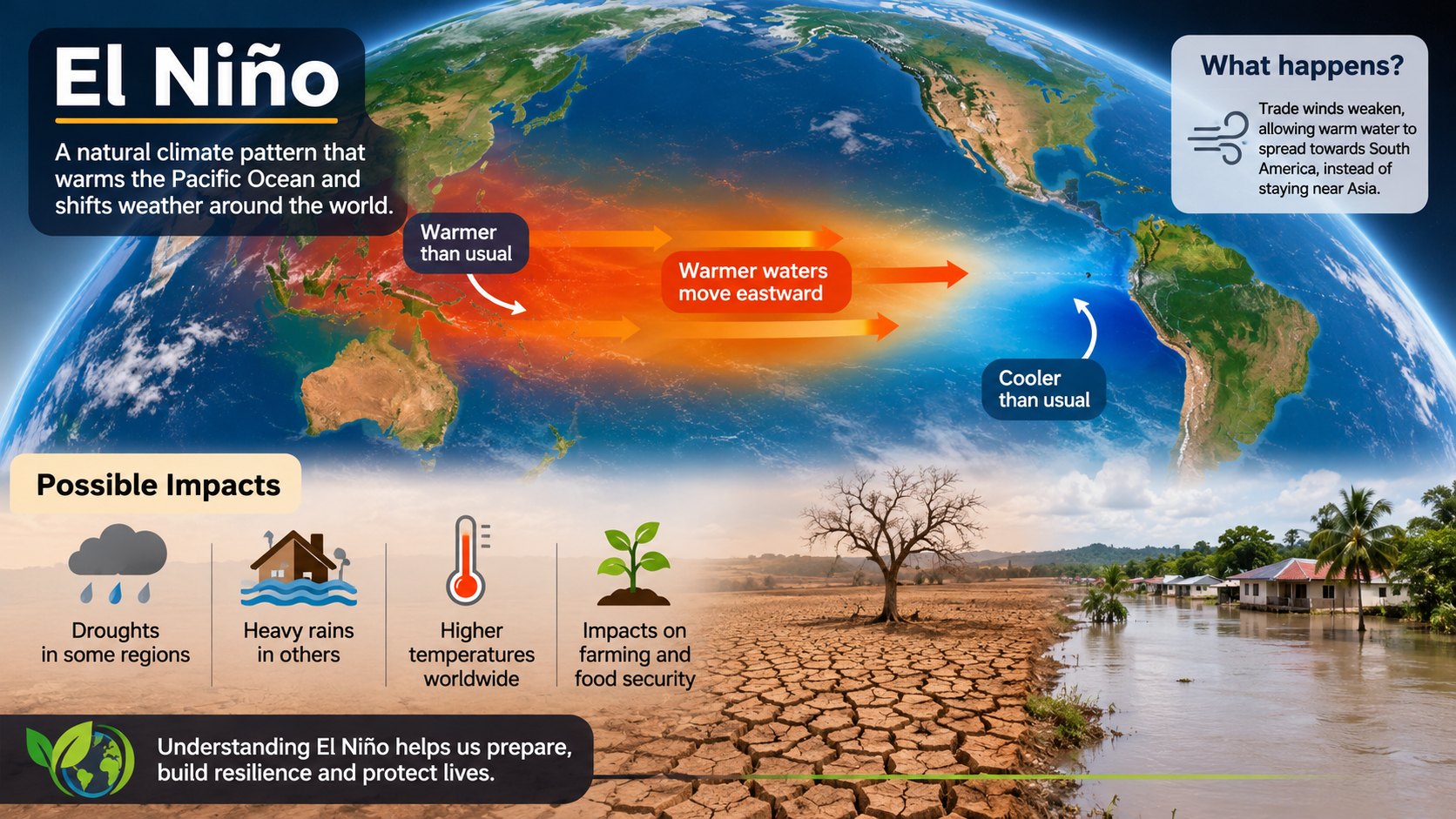
El Niño is not a storm, a hurricane or a sudden environmental disaster. It is a naturally occurring climate pattern that develops in the tropical Pacific Ocean and influences atmospheric circulation, changing weather conditions in different parts of the world.
Its effects can extend far beyond the ocean where it begins, influencing agriculture, water availability, ecosystems and human livelihoods.
What Exactly Is El Niño?
El Niño is the warm phase of a climate cycle known as the El Niño-Southern Oscillation (ENSO).
It occurs when surface waters in the central and eastern equatorial Pacific Ocean become warmer than their long-term average.
Under normal conditions, easterly trade winds push warm surface water towards Southeast Asia and Australia. This allows cooler, nutrient-rich water to rise near the coast of South America, supporting marine ecosystems and maintaining the ocean’s usual temperature distribution.
During El Niño, these trade winds weaken.
Warm water begins moving eastward across the Pacific, reducing the normal upwelling of cooler water. This changes the distribution of heat and moisture in the atmosphere, influencing weather patterns across several continents.
El Niño events typically occur every two to seven years and generally last between nine and twelve months, although some can persist longer.
The opposite phase is called La Niña, which is associated with unusually cool surface waters in the central and eastern tropical Pacific.
How Can One Ocean Influence the Entire World?
The atmosphere and oceans are deeply interconnected.
When large areas of the Pacific Ocean become unusually warm, more heat and moisture are transferred into the atmosphere. This changes patterns of rising air, atmospheric pressure, wind circulation and rainfall.
These changes can influence weather systems thousands of kilometres away.
However, El Niño does not produce identical conditions everywhere.
Some regions experience unusually dry conditions, while others receive excessive rainfall. Some experience warmer temperatures, while others experience different seasonal weather patterns.
Commonly observed impacts include:
- Droughts and reduced rainfall in parts of Australia and Southeast Asia.
- Increased rainfall and flooding in parts of South America.
- Changes in tropical storm activity.
- Increased temperatures in several parts of the world.
- Disruptions to agricultural production and marine ecosystems.
Importantly, these are typical climate influences, not guaranteed outcomes. Every El Niño event is different.
What Does El Niño Mean for Agriculture?
Agriculture depends heavily on predictable environmental conditions.
Farmers need sufficient rainfall, suitable temperatures, healthy soils and reliable access to water. When these conditions become unpredictable, agricultural productivity can suffer.
El Niño can disrupt planting calendars, shorten growing seasons in some regions and increase the risk of crop failure.
For smallholder farmers, the consequences can be particularly serious.
A delayed rainy season may mean planting too early or too late. Reduced rainfall can affect germination and crop development, while excessive rainfall can cause waterlogging, soil erosion and damage to standing crops.
Livestock production can also be affected when drought reduces pasture availability and water resources.
The consequences do not stop at the farm.
Lower agricultural production can contribute to food price increases, reduced household incomes, food insecurity and greater pressure on already vulnerable communities.
Is El Niño the Same as Climate Change?
No. This distinction is important.
El Niño is a natural climate phenomenon that has existed for thousands of years.
Climate change refers to long-term shifts in global temperatures and weather patterns, primarily driven by human activities that increase greenhouse gas concentrations in the atmosphere.
However, the two phenomena can interact.
A warming global climate can influence the background conditions in which El Niño develops. When El Niño occurs, its natural warming influence can temporarily add to the existing global temperature increase.
This means that particularly strong El Niño events can contribute to exceptionally warm global years.
Understanding the difference helps us distinguish between natural climate variability and the longer-term changes associated with human-induced global warming.
Why Climate Information Matters More Than Ever
One of the greatest challenges facing agriculture and vulnerable communities is not simply changing weather. It is the difficulty of making decisions when environmental conditions become less predictable.
Climate information can help address this challenge.
Seasonal forecasts, satellite observations, rainfall monitoring and agricultural advisory services can provide valuable information to farmers, governments and development organisations.
With reliable information, farmers can make better-informed decisions about:
- When to prepare land and plant crops.
- Which crops and varieties are more suitable for expected conditions.
- How to manage limited water resources.
- When to adjust farming practices.
- How to prepare for potential droughts or excessive rainfall.
Technology is increasingly making environmental information more accessible.
Satellite monitoring, artificial intelligence and weather intelligence systems can help transform complex environmental data into practical information that farmers can understand and use.
Preparing for a Climate That Does Not Always Follow Expectations
El Niño reminds us that the world’s climate system is interconnected.
An unusual temperature change in one ocean can influence weather conditions, agricultural production and livelihoods across distant regions.
We cannot prevent El Niño from occurring. However, we can improve how we understand it, prepare for its effects and protect communities from climate-related risks.
The future of agriculture will depend not only on what we grow, but also on how well we understand the environment in which we grow it.
Because sometimes, the difference between a successful harvest and a failed season begins with information.